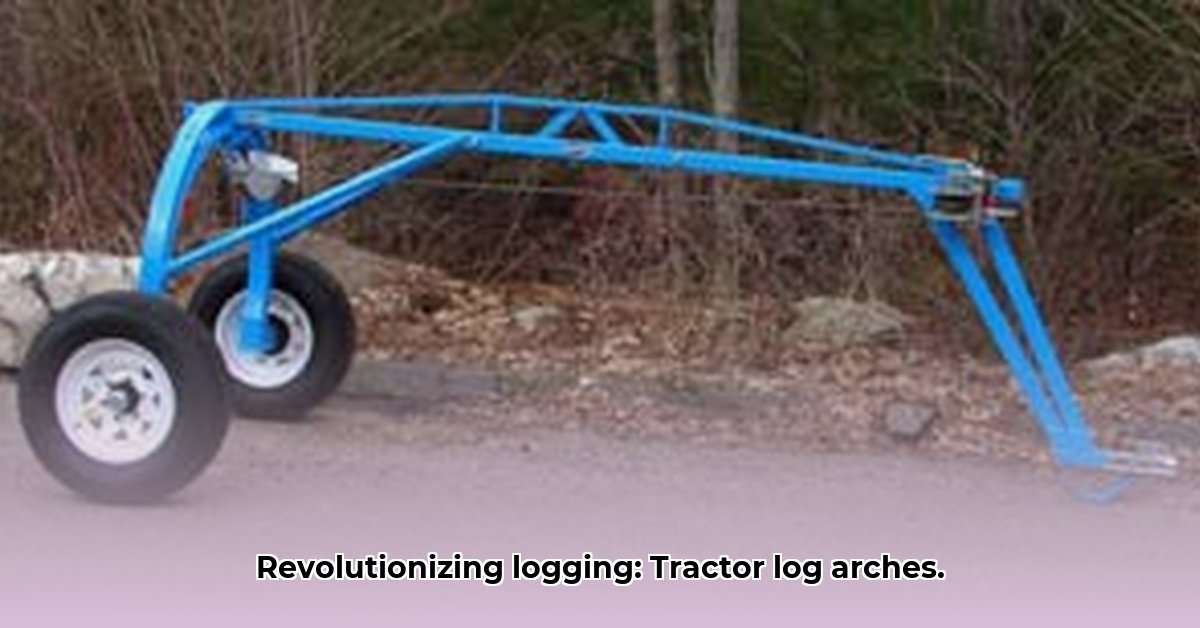
Tractor Log Arches: Power and Precision in Sustainable Forestry
Efficient log handling is paramount for sustainable forestry practices. Two primary systems dominate the field: tractor log arches and standard log arches. Each presents a unique set of advantages and disadvantages, influencing their suitability for different operations. This guide analyzes both to help you choose the optimal system for your needs. For more in-depth information on log handling equipment, check out this helpful resource.
Tractor Log Arches: The Heavyweights of Log Handling
Tractor log arches, exemplified by models like the Logrite T30 and T36, represent a significant leap in log handling capabilities. The Logrite T30 boasts a 4000-pound capacity and handles logs up to 16 feet long, while the T36 increases this to 6000 pounds and 18 feet. This translates directly into increased efficiency: fewer trips mean reduced time and labor costs. The integrated winches and refined choker systems streamline the process, improving safety and speed.
Advantages of Tractor Log Arches:
- High Capacity: Move significantly heavier and longer logs per load, maximizing productivity. Isn't this a significant improvement over manual handling?
- Enhanced Efficiency: Fewer trips equate to reduced operational time and lower labor costs. How much time can this save in a typical work day?
- Improved Safety: Mechanized handling minimizes the risk of accidents and injuries associated with manual log movement.
- Streamlined Workflow: Integrated winches and user-friendly systems accelerate logging operations.
Disadvantages of Tractor Log Arches:
- High Initial Investment: The substantial upfront cost requires careful budgeting and long-term planning.
- Maneuverability Limitations: Their larger size can restrict movement in confined spaces or challenging terrain.
Standard Log Arches: A Sustainable and Budget-Friendly Approach
Standard log arches, the smaller, lighter counterparts of tractor arches, offer a cost-effective and environmentally conscious alternative. Their reduced weight minimizes soil compaction, making them ideal for ecologically sensitive areas. This makes them particularly suitable for smaller operations or those prioritizing minimal environmental impact. However, this lighter build comes with a trade-off: lower lifting capacity and increased trip frequency.
Advantages of Standard Log Arches:
- Lower Initial Cost: Makes them accessible to smaller businesses or those with limited capital.
- Reduced Environmental Impact: Minimizes ground disturbance and soil compaction.
- Improved Maneuverability: Easier to navigate tight spaces and challenging terrain.
Disadvantages of Standard Log Arches:
- Lower Capacity: Requires more trips, translating to increased time and labor costs. How does this impact overall operational efficiency compared to tractor arches?
- Reduced Efficiency: Handles fewer logs per trip, potentially affecting overall productivity.
- More Physically Demanding: May lead to increased worker fatigue due to the need for more manual handling.
Comparative Analysis: Choosing the Right Arch for Your Operation
The choice between tractor and standard log arches depends heavily on specific operational considerations. The following table summarizes key differences:
| Feature | Tractor Log Arch | Standard Log Arch |
|---|---|---|
| Lifting Capacity | High (4000-6000 lbs, 16-18 ft logs) | Low |
| Efficiency | High | Low |
| Initial Cost | High | Low |
| Environmental Impact | Moderate | Low |
| Maneuverability | Low | High |
Selecting Your Ideal Log Arch: A Decision Framework
The ideal log arch depends on your specific operational context:
Large-Scale Commercial Logging: Tractor arches maximize efficiency and return on investment, despite the higher initial cost. Their high capacity significantly offsets the increased upfront expense.
Small-Scale Operations/Sustainable Forestry: Standard arches provide a balance between cost-effectiveness and environmental responsibility. Their lower impact is a key advantage in sensitive ecosystems.
Urban Forestry: Maneuverability is paramount in urban environments. The compact design of standard arches makes them safer and more practical within restricted spaces.
Beyond these factors, terrain, log size, and budget will influence your decision. Prioritize safety through thorough operator training and adherence to all relevant regulations.
Safety and Regulatory Compliance: A Critical Consideration
Safety must be paramount. Both log arch types present inherent risks. Comprehensive operator training, regular equipment maintenance, and strict adherence to all applicable safety regulations are non-negotiable aspects of responsible log handling.
Conclusion: Optimizing Forestry Practices Through Informed Equipment Selection
The selection of log arches directly impacts operational efficiency and environmental sustainability. By carefully considering capacity requirements, budget constraints, operational scale, and environmental impact, foresters can optimize their practices and ensure long-term productivity and resource stewardship. Remember, ongoing research and technological advancements will continually refine log handling practices, potentially transforming future approaches to this critical element of forestry.